
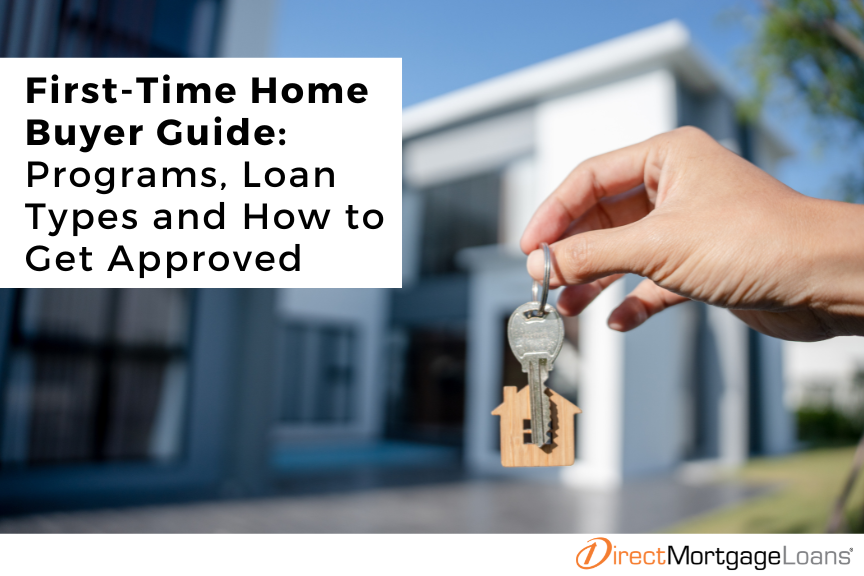
First-Time Home Buyer Guide: Programs, Loan Types and How to Get Approved
Buying your first home comes with a lot of questions. What programs do you qualify for? How much do you need to put down? What does the approval process actually look like? This first-time home buyer guide walks you through every major loan type, every assistance program worth knowing and exactly what lenders look for all in one place. If you’re ready to explore your options now, visit our Home Buyer Guide or check out our full Loan Products page.


What Is a First-Time Home Buyer?
The U.S. Department of Housing and Urban Development (HUD) defines a first-time home buyer as anyone who has not had ownership in a principal residence during the three years leading up to their purchase date.
That definition is broader than most people expect. Even if you have owned a home before, you may still qualify as a first-time buyer under this rule.
First-Time Home Buyer Loan Programs: What Are Your Options?
There is no single best loan for every buyer. The right program depends on your credit score, income, down payment funds and where you are buying. For a full overview, see Different Types of Home Loans for Home Buyers. Here is a breakdown of the five most common first-time home buyer loan programs.
Conventional Loans
A conventional loan is not backed by the government. It meets the lending requirements set by Fannie Mae or Freddie Mac and is one of the most flexible mortgage options available.
Who it works best for: Buyers with a solid credit score who want flexibility in their mortgage insurance options.
- Down payment as low as 3% for first-time buyers through affordable housing programs
- No mortgage insurance required with 20% or more down
- If you put down less than 20%, you can work with your loan officer to choose the mortgage insurance structure that fits your situation
- Less restrictive property requirements compared to government-backed loans. See FHA vs Conventional Loan: How To Choose The Best Option For You for a side-by-side comparison.
FHA Loans
FHA loans are backed by the Federal Housing Administration and governed by HUD. They are among the most popular options for first-time buyers because of their low down payment and flexible credit requirements. Learn more on our FHA Loan page. If you want to purchase with no money down, ask about our Go Direct FHA 100 Mortgage Financing program, which combines a first and second mortgage to achieve 100% financing with no down payment required.
Who it works best for: Buyers with limited savings or an imperfect credit history.
- Down payment as low as 3.5%
- Gift funds and grants may be used toward your down payment. See Gift Funds for Down Payment for details.
- More flexible credit score requirements than conventional loans
- Upfront mortgage insurance can be financed into the loan or paid at closing. Read about FHA Mortgage Insurance Reduction.
- Private mortgage insurance (PMI) is not cancelable on FHA loans
- Cannot be used for second homes, investment properties or most condominiums. See What You Should Know About FHA Condos.
- Loan limits vary by county and property type. See FHA Loan Limits for current figures.
FHA Forward Mortgage Loan Limits for 2026
| Property Size | Low-Cost Area “Floor” | High-Cost Area “Ceiling” |
| One-Unit | $541,287 | $1,249,125 |
| Two-Units | $693,050 | $1,599,375 |
| Three-Units | $837,700 | $1,933,200 |
| Four-Units | $1,041,125 | $2,402,625 |
USDA Loans
USDA loans are backed by the Rural Housing Division of the United States Department of Agriculture. They are available to low-to-moderate income buyers purchasing in eligible rural and suburban areas. Visit our USDA Loans page to learn more.
Who it works best for: Buyers purchasing in USDA-eligible locations who want to minimize upfront costs.
- No down payment required
- Minimum credit score around 600, though compensating factors may be needed at lower scores
- Guaranteed fee of 1% of the loan amount (can be financed into the loan)
- USDA rates are typically lower than conventional loan rates. See USDA Loan vs FHA Loan: Which One is Right for You? for a comparison.
- The property must be in a USDA-eligible location. Check eligibility before applying.
VA Loans
VA loans are offered through the Department of Veterans Affairs for eligible military service members, veterans and surviving spouses. Visit our VA Home Loans page for the full overview.
Who it works best for: Those who have served in the U.S. military and want to maximize their buying power with no down payment.
- Up to 100% financing available for eligible borrowers, with no monthly mortgage insurance
- No current cap on loan amounts for eligible borrowers with full entitlement
- VA loans are assumable, meaning another eligible buyer may be able to take over your loan. Read VA Loan Assumption: Are VA Loans Assumable?.
- Eligible properties include stick-built homes, condominiums and manufactured homes
- Cash-out refinancing up to 100% of the home’s value may be available
Specialty Loans
Specialty loan programs are designed for buyers with unique circumstances that may not fit conventional or government loan requirements.
Good Neighbor Next Door: Eligible teachers, law enforcement officers, firefighters and EMTs may qualify for a 50% discount off the list price of select HUD properties in designated revitalization areas. Learn more about the Good Neighbor Next Door Program.
Fannie Mae HomeReady / Freddie Mac Home Possible: Designed for creditworthy, low-to-moderate income buyers with limited down payment funds. Up to 97% financing may be available. See Fannie Mae HomeReady and Freddie Mac Home Possible for details.
Non-QM Loans: For buyers who are self-employed, have non-traditional income, or cannot meet the standard documentation requirements for a conventional loan. These are an alternative path to homeownership for buyers outside standard guidelines. See What Are Non-QM Loans? to explore this option.
How Do I Qualify for a First-Time Home Buyer Loan?
Lenders evaluate several factors during the pre-approval process. For a full checklist, see Documents Needed for Mortgage Pre-Approval. Here is what you can expect lenders to review:
Debt-to-income (DTI) ratio: Your DTI is the percentage of your gross monthly income that goes toward debt payments. A lower ratio improves your approval odds and shows lenders you have room in your budget for a mortgage payment.
Proof of income: Pay stubs, W-2s and tax returns are standard. Some loan programs, including Non-QM loans, accept alternative documentation for self-employed borrowers.
Proof of assets: Bank statements showing you have enough for a down payment and closing costs.
Credit score: A higher credit score broadens your loan options and can help you qualify for better rates. Minimum scores vary by loan type. Read What Credit Score Is Needed To Buy A House? for a full breakdown.
Identification: Government-issued ID and a signed authorization for a credit check.
First-Time Home Buyer Assistance Programs
Beyond loan types, there are dedicated assistance programs designed specifically to help first-time buyers clear the biggest hurdles: the down payment and closing costs. Explore all available options on our Down Payment Assistance Programs page.
Down Payment Assistance (DPA) Programs
If your down payment funds are the main obstacle, you may qualify for a Down Payment Assistance program. There are over 2,000 DPA programs available nationwide. See What You Should Know About Down Payment Programs for a deeper look. They come in several forms:
Grants: Money toward your down payment that does not need to be repaid.
Loans: A second mortgage repaid monthly alongside your primary loan.
Deferred loans: A second mortgage with no payments due until you sell, move or refinance.
Forgivable loans: A second mortgage that is forgiven after a set number of years, typically five to 20, as long as you stay in the home. If you sell or refinance before that window closes, the balance becomes due.
Eligibility requirements vary by program, income level and location. Also see Is a 20% Down Payment Really Necessary? and How to Buy a House with No Money Down for related guidance. A loan officer can identify which DPA programs you qualify for in your area.
Go Direct FHA 100 Mortgage Financing
DML’s Go Direct FHA 100 Mortgage Financing program achieves 100% financing by combining a first and second mortgage compatible with FHA loans. The second mortgage covers up to 3.5% of the lesser of the sales price or appraised value and carries a 10-year term.
Key features of the program:
- No down payment required, making it accessible to buyers across all income levels
- Not limited to first-time buyers. Open to anyone who meets the eligibility requirements.
- No maximum debt-to-income ratio
- Buyers with less-than-perfect credit are welcome
- Non-occupant co-borrowers are permitted without restrictions
- Both amortized and forgivable options are available for the second lien
The program has helped over 48,300 individuals purchase homes, providing $417 million in down payment assistance.
Good Neighbor Next Door Program
Eligible public servants, including teachers, law enforcement officers, firefighters and EMTs, may qualify for a 50% discount off the list price of select HUD properties in designated revitalization areas. Read the full Good Neighbor Next Door Program guide, or visit our First Responders Program page.
Fannie Mae HomeReady and Freddie Mac Home Possible
These programs are designed for creditworthy, low-to-moderate income buyers with limited down payment funds. Up to 97% financing may be available, making homeownership accessible with as little as 3% down. Both programs also allow income from household members who are not on the loan to count toward qualification in some cases. Learn more: Fannie Mae HomeReady Loan: What It Is and How It Works | What Is Freddie Mac’s Home Possible Loan?.
Which Loan Is Easiest to Get Approved For?
FHA loans are generally the most accessible for first-time buyers due to their lower credit and down payment thresholds. That said, USDA and VA loans can be even easier to qualify for in the right circumstances, as no down payment is required for either. See USDA Loan vs VA Loan: Which Is Right for You? for a direct comparison.
The straightforward answer: apply for the loan you are most qualified for. Use our Mortgage Calculators to run the numbers, or review our Mortgage FAQs. Your loan officer will review your full financial picture and match you to the right program.
First-Time Home Buyer Guide: Frequently Asked Questions
What credit score do I need as a first-time home buyer? It depends on the loan program. FHA loans allow lower scores with a larger down payment. USDA loans typically require around 600. Conventional loans generally work best at 620 or higher. VA loans have no official minimum, though individual lenders set their own thresholds. Read Credit Score Factors for First-Time Home Buyers for more detail.
What first-time home buyer programs are available? The most widely available programs include FHA loans, USDA loans, VA loans (for eligible service members), Down Payment Assistance grants and loans, Fannie Mae HomeReady, Freddie Mac Home Possible and the Good Neighbor Next Door program. See First Time Home Buyer Loan Options and Programs for a full list.
Can I use gift money for a down payment? Yes. FHA loans allow down payment funds to come from gifts. Conventional loans also allow gift funds in certain circumstances. Read Gift Funds for Down Payment for documentation requirements. If saving for a down payment is the main obstacle, also ask about the Go Direct FHA 100 Mortgage Financing program. It combines a first and second mortgage to cover 100% of the purchase price, requires no down payment, has no maximum debt-to-income ratio, and is open to buyers at all income levels, not just first-time buyers. The program has helped over 48,300 individuals purchase homes, providing $417 million in down payment assistance.
What is PMI and can I avoid it? PMI (private mortgage insurance) protects the lender if you default. On conventional loans, PMI can be removed once you reach 20% equity. On FHA loans, it is not cancelable. VA and USDA loans do not require monthly PMI. Read Private Mortgage Insurance vs. Lender-Paid Mortgage Insurance for a full breakdown.
How long does the home buying process take? It varies based on loan type, market conditions and how quickly you can provide documentation. Read How To Buy A House: Steps To Buying A House In Today’s Market. Starting with a pre-approval puts you in the strongest position from day one.
What is the difference between pre-qualification and pre-approval? Pre-qualification is a quick estimate based on self-reported information. Pre-approval involves a verified review of your credit, income and assets and carries much more weight with sellers. Read The Difference Between Pre-Approval and Pre-Qualification for more detail.
What are closing costs and how do I pay them? Closing costs are fees paid at the end of the transaction. Read What Are Closing Costs and How to Pay Them? for a full breakdown of what to expect.
Ready to Find Your First-Time Home Buyer Program?
Every buyer’s situation is different. A Direct Mortgage Loans loan officer will review your financial picture, match you to the right loan program and identify any assistance programs available in your area. Use our find a loan officer tool to connect with someone in your area, or get a rate quote to see where you stand.

About the Author: Anna Dowling
Was this article helpful?
Your feedback helps us create better content.
About the Author: Anna Dowling
Was this article helpful?
Your feedback helps us create better content.
Related Articles
What Is a Single-Family Home?
2026-09-28T10:45:26-05:00By Anna Dowling|
VA Loans for First-Time Buyers
2026-09-21T09:56:30-05:00By Anna Dowling|Tags: VA Loan|