


How To Buy a House in Virginia as a First Time Home Buyer
Navigating the homebuying process can feel overwhelming, especially if you’re new to it. But you’re not alone. Whether you’re dreaming of a cozy condo in Richmond or a family home in the suburbs of Northern Virginia, this guide is here to help. From connecting with our licensed Virginia mortgage experts to closing on your new home, here’s what to expect along the way:
Speak with one of our Licensed Virginia Mortgage Lenders
Connect with one of our licensed Virginia mortgage loan officers to discover homebuyer programs tailored to your needs and find out if you qualify.
Gather Your Documents & Start the Pre-Approval Process with a Go Direct Approval
Begin your Go Direct Approval for a faster, more streamlined mortgage process. With basic documents like W-2s and bank statements, we can quickly tailor your loan and speed up approval.
*When compared to turn times for conventional programs. Approval times may vary depending on individual circumstances.
Go Under Contract
After you’ve found your ideal home, our loan coordinator will guide you through the next steps, including inspections and appraisal, to keep everything moving smoothly
Home Appraisal
We utilize an advanced appraisal software system that ensures clear communication and coordination across our team. By partnering with top-tier professionals, we deliver a smooth, efficient appraisal process from start to finish.
Processing
Before your loan file moves to underwriting, our processor will carefully review everything to ensure its complete and accurate. At this stage, we may reach out for clarification or request additional documentation to keep things on track.
Final Mortgage Approval
Our in-house underwriter will complete a final review of your loan file to confirm all conditions have been met. Once approved, you will receive your final loan commitment, putting you just one step away from closing on your new home.
Closing On Your New Home
As you approach closing, our team will confirm the total funds needed to finalize your purchase. We’re here to make sure everything goes smoothly so you can enjoy the excitement of becoming a homeowner.
First Time Home Buyer Virginia Loan Options
There are a variety of loan products available in Virginia, each tailored to meet the needs of different types of homebuyers. Whether you’re a first time home buyer, a veteran, or looking for low down payment loan options, here’s a breakdown of some of the most common home loan types.
FHA Loans
FHA loans are a popular choice for first time buyers who may have lower credit scores or limited savings. Backed by the Federal Housing Administration, these loans allow for down payments as low as 3.5% if your credit score is 580 or higher. Even buyers with scores as low as 500 may qualify with a 10% down payment. While FHA loans do require mortgage insurance, they offer more lenient credit and income requirements, making them a great steppingstone into homeownership.
VA Loans
For eligible veterans, active-duty service members, and surviving spouses, VA loans offer one of the most powerful paths to homeownership. These loans are partially backed by the Department of Veterans Affairs, which allows lenders to offer more favorable terms. With a VA loan, you can purchase a home with no down payment, no private mortgage insurance (PMI), and competitive VA mortgage rates. The program is designed to honor your service by making homeownership more accessible and affordable.
USDA Loans
If you’re looking to buy a home in a rural or suburban area of Virginia, a USDA loan might be the perfect fit. A USDA loan is a type of government-backed mortgage designed to help individuals with low-to-moderate income in specific rural areas purchase a home. One of the biggest advantages is that USDA loans require no down payment and no PMI, making them a great option for first time buyers who qualify based on location and income.
Conventional Loans
Conventional loans are a strong choice for first time buyers who have good credit and some savings. Unlike government-backed loans, conventional loans are not insured by a federal agency, but they follow guidelines set by Fannie Mae and Freddie Mac. These loans offer a wide range of down payment options and more flexibility in choosing mortgage insurance. They’re ideal for buyers who want more control over their loan structure and are comfortable meeting stricter credit and income requirements.
Conventional 97 Loans
The Conventional 97 loan is a great option for first time home buyers who want to minimize their upfront costs. With just a 3% down payment required, this loan allows you to borrow up to 97% of the home’s value. It’s a practical solution for buyers who have steady income and good credit but haven’t had time to save a large down payment.
Fannie Mae HomeReady
HomeReady is a Fannie Mae program designed to help low- to moderate-income buyers, especially in high-cost areas. With a down payment requirement of just 3%, it’s accessible to many first time buyers. Additionally, eligible borrowers may receive a $2,500 credit that can be used toward the down payment or closing costs. HomeReady also allows for flexible income sources, including contributions from household members who aren’t on the loan.
Freddie Mac Home Possible
Freddie Mac’s Home Possible program is another excellent option for first time buyers with moderate incomes. Like HomeReady, it requires only a 3% down payment and offers reduced private mortgage insurance (PMI) costs. Home Possible also provides flexibility in how income is calculated and allows co-borrowers on the loan who do not plan to live in the home. The leniency in co-borrower additions helps make Home Possible loans easier for families to support each other in the buying process.
Piggyback Loans
A piggyback loan is a creative financing strategy that can help you avoid PMI and reduce your out-of-pocket costs. This approach involves taking out two loans simultaneously: a primary mortgage and a smaller second mortgage. The second loan covers part of the down payment, allowing you to keep your primary loan under 80% of the home’s value. This can be especially useful for buyers purchasing higher-priced homes who want to avoid the added cost of mortgage insurance.
Virginia Down Payment Assistance & Home Buying Programs Through Direct Mortgage Loans
Direct Mortgage Loans is proud to offer a variety of home buying solutions to eligible buyers in Virginia, including the Go Direct FHA 100% Financing program, which provides a powerful path to homeownership with no down payment required. In addition, we support those who serve our communities through our Law Enforcement Home Buying program, offering exclusive mortgage benefits for police officers and first responders as a lending partner of the Fraternal Order of Police.
Go Direct FHA 100% Financing for Virginia Home Buyers
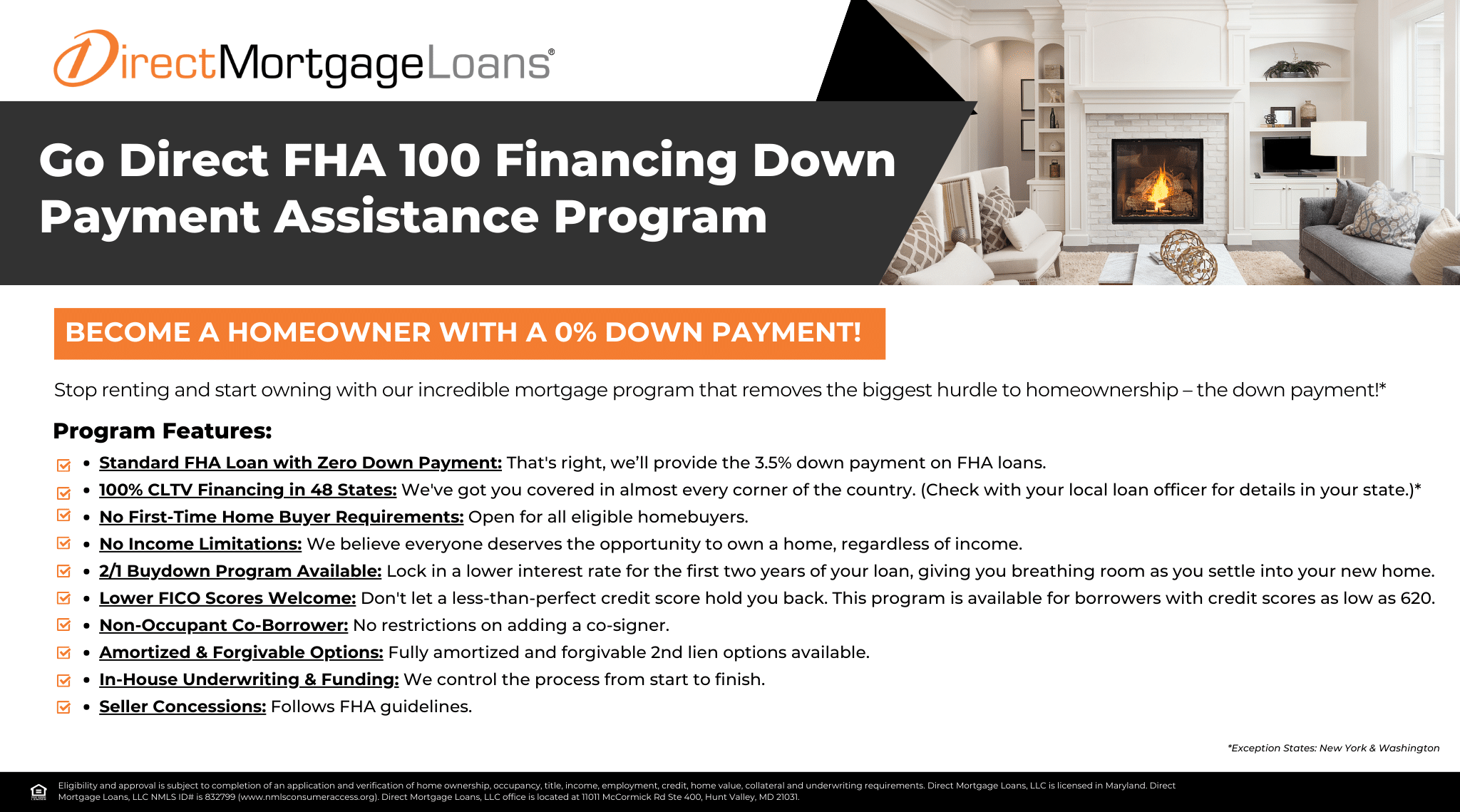
This is achieved by combining a 1st and 2nd mortgage and is compatible with FHA loans. The 2nd mortgage can be up to 3.5%, based on the lesser of the sales price or appraised value, and has a 10-year term.
Go Direct FHA 100% Financing Benefits for Virginia Home Buyers
The Go Direct FHA 100 loan is designed to enhance homeownership opportunities by offering key benefits that boost both accessibility and affordability.
- 0% Down Payment
- Standard FHA Guidelines
- Second Lien Financing
These benefits make the Go Direct FHA 100 loan an exceptional choice for eligible buyers aiming to reduce upfront homebuying costs.
Go Direct FHA 100% Requirements for Virginia Home Buyers
To qualify for this program, applicants must meet the following criteria:
- Minimum FICO credit score of 620
- Completion of a Home Buyer Education course to better understand the home buying process
Eligible Property Types Include:
- Single-family homes
- Duplexes
- PUDs (Planned Unit Developments)
How do I apply for the Go Direct FHA 100% Financing Program as a first time home buyer in Virginia?
To apply for the Go Direct 100% FHA Financing Loan Program in Virginia, follow these steps:
- Apply with Direct Mortgage Loans: Begin by submitting your application with Direct Mortgage Loans. Our experienced team will walk you through the process and help you understand your financing options.
- Verify Eligibility and Get Pre-Approved: Once your mortgage application is submitted, the next step is to verify your eligibility for the program. If you qualify, Direct Mortgage Loans will assist you in obtaining a pre-approval, which helps determine your homebuying budget.
- Complete a Homebuyer Education Course: At least one borrower must complete a Homebuyer Education Course. This course is designed to prepare you for the responsibilities of homeownership and is a required part of the program.
- Close on Your New Home: After you’ve been approved and completed the education course, you’ll be ready to close on your new home. This final step brings you one step closer to becoming a homeowner.
Direct Mortgage Loans Law Enforcement Home Buying Program
As a lending partner of the Fraternal Order of Police, Direct Mortgage Loans is proud to make homeownership possible for those in law enforcement. We offer exclusive mortgage benefits for cops through our specialized law enforcement home buying programs for FOP members. Protecting and serving the community is no easy job. Thankfully, for police officers and first responders, buying a home is a much less stressful process.
Direct Mortgage Loans Law Enforcement Home Buying Program Benefits
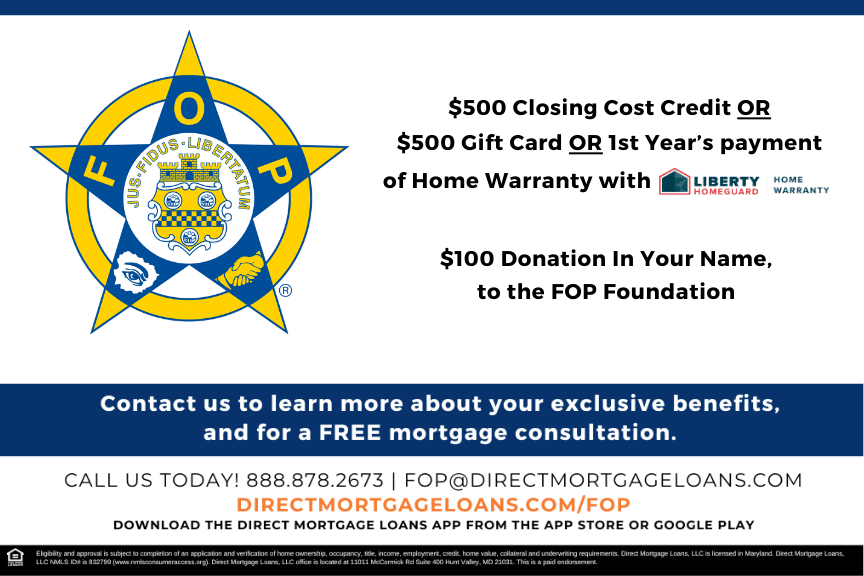
As a Law Enforcement Officer, you get to choose from one of the following benefits:
- $500 Closing Cost Credit
- $500 Gift Card
- First Year’s Payment of a Home Warranty through our partnership with Liberty Home Guard
Additionally, we will donate $100 to the FOP Foundation in the name of the FOP member, supporting the foundation’s important causes.
Other Ways to Buy a House as a First Time Home Buyer in Virginia
Buying your first home in Virginia is an exciting milestone but coming up with a down payment can sometimes feel like the biggest hurdle. The good news is that there are several creative and practical ways to make homeownership more achievable, even if you don’t have a large amount saved. From receiving financial help from family to tapping into your retirement savings or investment accounts, these alternative strategies could help bridge the gap and get you closer to owning your first home. Let’s explore some of the most effective ways to fund your down payment and make your dream of homeownership a reality.
Gift Funds
If you have family members who are willing to support your journey to homeownership, gift funds could be a valuable resource. These are monetary gifts from relatives which could be used toward your down payment. However, the rules around gift funds vary depending on the type of mortgage you choose. Some loan programs allow the entire down payment to be gifted, while others may require you to contribute a portion from your own funds. It’s important to communicate with your loan officer early in the process if you plan to use gift funds, so they can guide you toward the mortgage product that best fits your financial situation and ensure all documentation is handled correctly.
Borrow From 401(k)
If you’ve been contributing to a 401(k), you might consider borrowing from it to help cover your down payment. This option allows you to access your retirement savings without permanently withdrawing the funds. Essentially, you’re borrowing from yourself and repaying the loan over time, usually through payroll deductions. While this can be a convenient way to access cash, it’s important to understand the potential drawbacks. There may be tax implications, and if you leave your job before the loan is repaid, the remaining balance could become due immediately. Be sure to weigh the pros and cons carefully and consult with a financial advisor before moving forward.
Savings
Saving for a down payment is one of the most straightforward and responsible ways to prepare for homeownership. Even if you can only set aside a small amount each month, consistent saving can add up overtime. Consider using a high-yield savings account to grow your funds faster and create a budget that prioritizes your homebuying goal. This approach not only helps you build financial discipline but also strengthens your mortgage application by showing lenders that you’re financially prepared.
Cash Out on Investments
If you’ve built a portfolio of investments, you might consider cashing out a portion to use for your down payment. This could be a smart move if your investments have appreciated significantly and you’re ready to transition those gains into a long-term asset like a home. However, selling investments can have tax consequences and may reduce your future earning potential. It’s a good idea to speak with a financial advisor before making any decisions, so you can understand the impact on your overall financial plan and ensure it aligns with your long-term goals.
First Time Home Buyer Virginia FAQ’s
Who is considered a first time home buyer in Virginia?
In Virginia, you’re considered a first time home buyer if you haven’t owned a primary residence in the last three years. This includes individuals who may have owned rental or investment property, but not a home they lived in as their main residence.
How much do first time home buyers have to put down in Virginia?
The amount needed for a down payment on a home in Virginia depends on the type of loan and your financial situation. However, if you qualify for a USDA or VA loan, you may be able to purchase a home with no money down.
Can you buy a home in Virginia with no money down?
Yes, eligible homebuyers could purchase a home in Virginia with no money down. Programs like the Go Direct 100% FHA financing may be available through certain lenders. Additionally, if you qualify for a VA or USDA loan, there is no down payment requirement, making homeownership more accessible for many Virginians.
What is the minimum credit score to buy a house in Virginia?
In Virginia, the minimum credit score required for a mortgage depends on the type of loan you choose. While a score of 620 is typically recommended, some programs may require a minimum of 640 or higher to qualify. However, Direct Mortgage Loans offers options for borrowers with credit scores as low as 580, providing more flexibility for those with less-than-perfect credit.


Leave A Comment
You must be logged in to post a comment.